

Evaluate PowerStic-AI. Build a measured savings case.
For data-center and infrastructure teams, PowerStic-AI offers a USB-based way to evaluate switching-energy recovery on active servers. Understand the mechanism, test representative hardware, and turn measured watts into a purchasing decision.
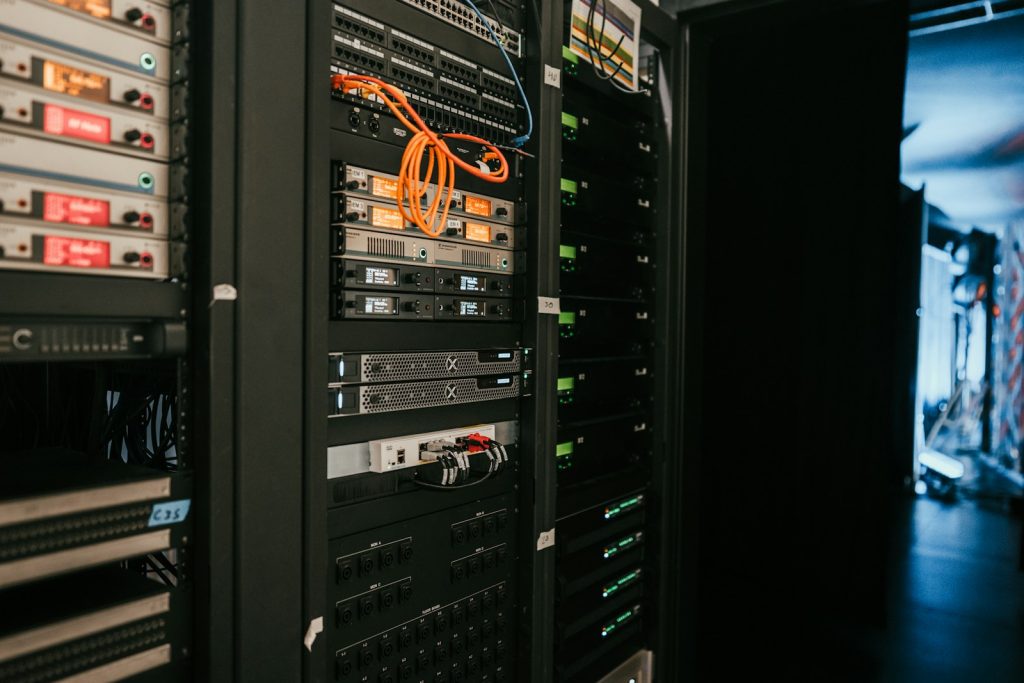
Server infrastructure · Photo by Kevin Ache / Unsplash.
Why active equipment is the starting point
Digital switching generates high-frequency noise on the power network. The CC-100 is designed to recover a portion of the energy associated with that noise and feed it back into the supply.
PowerStic-AI packages this circuitry in a USB device connected to power and ground only. Its data pins are unconnected. Confirm port and system compatibility when planning the trial.
Reported PowerStic-AI server results
286 → 276 W
CurrentRF’s PowerStic-AI brief reports a composite 10 W reduction, about 3.5%, across three HP ProLiant DL560 Gen8 servers at PayPal. Tests alternated 24-hour periods with the device inserted and removed.
The report records workload and operating-system variation between days. Treat these system-specific results as a reason to test, rather than a forecast for a different server or AI workload.
A pilot that answers the buying question
Agree on compatible hardware, a representative workload, and a minimum savings target before ordering a pilot quantity.
Measure system power
Measure at the same whole-system power point with the device inserted and removed. Use repeated runs and record measurement uncertainty.
Match the operating conditions
Keep hardware, workload, throughput, and test duration comparable. Log temperature and configuration changes so a power difference can be interpreted.
Convert watts into a business case
Monthly energy saving = measured watts saved × operating hours ÷ 1,000. Multiply kWh by your electricity rate; compare the result with current device and deployment costs.
What 10 W could mean for your budget
Illustration: a sustained 10 W reduction over 720 hours saves 7.2 kWh per server in a 30-day month. At $0.25/kWh, that is $1.80 per server, or $180 across 100 comparable servers. This excludes cooling effects and assumes the same measured saving on each server.
Start small. Scale on evidence.
Send your server models, workload, USB-port details, pilot quantity, and planned rollout size. Ask for current PowerStic-AI availability and pricing, then use the pilot results to decide the next purchase.